Blog

171a7a_a2fdba36f40742f1aaec6b5cfb6ff542mv2.jpg

September 8, 2016 0

A survey of laws and policies of 193 United Nations (UN) member states reveals a significant level of discrimination against individuals with mental illness in the areas of marriage, voting rights, and employment, among others.

Key findings of the survey, funded by the World Psychiatric Association (WPA) and released September 5 on World Mind Matters Day, include the following:


171a7a_3aa64720569345d087c4633aa05bd599mv2_d_2000_1499_s_2-1200x899.jpg

September 2, 2016 0

We often wonder if there are things that we are doing in our daily routine that actually increase our feelings of depression and anxiety. We also wonder if there are simple changes that we can make in our lives to decrease these feelings and provide us some relief. There are indeed things that we don’t think twice about during our day that add to our feelings of depression and anxiety, as well as unassuming changes that we can make in our lives, without much effort, to help reduce these feelings. We will discuss both below. We will talk over the things that increase depressive and anxious feelings while discussing what we can do about them. The changes will likely be far simpler than you have ever thought.


171a7a_45ffc0dda9f94f769a9bd528d734b5dcmv2-1200x674.jpg

August 30, 2016 0

New findings suggest that most Americans with depression receive no treatment, while raising the possibility that overtreatment of depression is also widespread. Less than a third of American adults who screened positive for depression received treatment for their symptoms, whereas over two-thirds of adults receiving treatment for depression did not report symptoms of depression or serious psychological distress, according to a study from Columbia University Medical Center (CUMC) and the University of Pennsylvania.


171a7a_4353e13325f44e10b2b3f9c078043d75mv2-1200x800.jpg

August 27, 2016 0

One of the many challenges clinicians have in treating patients with a chronic mental or physical illness is the risk of their developing a substance use disorder as a form of self-medication. For a long time, nicotine and alcohol—given their ease of acquisition—have been common addictions of concern; today, however, two other substances are rapidly rising in prevalence—opioids and marijuana.


mappurple.jpg

August 26, 2016 0

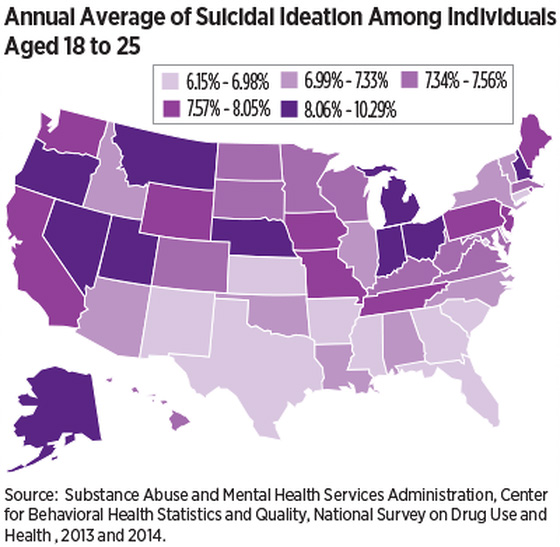
Experts say that high rates of suicidal ideation among young adults underscore a need for access to mental health care.

An estimated 2.6 million adults aged 18 to 25 in the United States—roughly 1 in 13 young adults—reported experiencing serious thoughts of suicide in the past year, according to a report by the Substance Abuse and Mental Health Services Administration (SAMHSA). The report offered a state-by-state comparison of suicidal ideation in this population.


171a7a_a9a359a465ba4d63ab49f3fa951ffd7bmv2-1200x675.jpg

August 16, 2016 0

By the time she was 61, Martha Rhodes had spent decades battling intractable depression. Diagnosis: treatment-resistant major depressive disorder. She’d tried a variety of medications to no avail; most were ineffective or caused nausea, diarrhea, weight gain and mood swings. During one particularly low evening in 2009, she attempted suicide. And every morning when she awoke, she experienced what she describes as “an emotional nausea – it was like this feeling of, ‘Why am I still here? Why do I have to be alive?’”


171a7a_4aae06d3ea9b41839c51006f306e8954mv2-1200x800.jpg

August 6, 2016 0

Substance abuse and dependence in bipolar disorder is a huge problem. More than half of people with bipolar disorder also experience substance use disorder. That rate is seven times higher than the United States average. These patients either abuse or are dependent on alcohol, marijuana or illicit drugs like opiates or amphetamines- perhaps even a combination. They also show symptoms earlier than average bipolar disorder patients and are hospitalized more often, making vigilance and treatment imperative.


171a7a_05bfeeccfb414bf49a6a7e9280cc5eaamv2_d_4200_2800_s_4_2-1200x800.jpg

August 2, 2016 0

Pregnant women and new mothers need more attention when it comes to screening for depression, according to recommendations issued Tuesday by the U.S. Preventive Services Task Force. That came as part of the panel’s recommendation that all adults should be screened, in a situation where they can be provided treatment or get a referral if they are clinically depressed.


171a7a_9f8a91d399f54ea58a1aecf49274a08fmv2-1200x675.jpg

July 30, 2016 0

Repetitive transcranial magnetic stimulation (rTMS) is a noninvasive method for applying electromagnetic fields to the brain. It is the application through a medical device of a low 0.9 Hertz frequency stimulation by an electromagnetic field to the brain. It requires more than one session. One of the side effects is a tendency to underestimate time. Another side effect may be a slight headache. It is contra-indicated in epilepsy and multiple sclerosis.


171a7a_75f1a0736e4c40fda817d980dd2f8c24mv2.jpg

July 27, 2016 0

Tinnitus is a frequent disorder which is very difficult to treat and there is compelling evidence that tinnitus is associated with functional alterations in the central nervous system. Targeted modulation of tinnitus-related cortical activity has been proposed as a promising new treatment approach. We aimed to investigate both immediate and long-term effects of low frequency (1 Hz) repetitive transcranial magnetic stimulation (rTMS) in patients with tinnitus and normal hearing.


For Life-Threatening Emergencies Call 911
 
Here at Awakenings we pride ourselves in restoring hope. Please contact us to begin your journey today.

Location

Awakenings KC
5300 W 94th Terrace #200,
Prairie Village, KS 66207

Select Language

X